Shouldn't Rapists Be In Prison?
Yes, rapists should be in prison. That may sound obvious, but that’s rarely the outcome of a rape case. The way victims are treated in society and in court is extremely corrupt. The victims are commonly blamed for it, aren’t believed, or don’t receive justice. While the rapists tend to walk free. According to the Crisis Center, 15 out of 16 rapists will walk free. Only 30% of victims reported their assault.
Clearly, there are many problems here. What are the reasons why so little victims report their attack? Why do so little rapists actually go to jail? The reason’s lie within social misconceptions and the justice system.
Let’s break down the social misconceptions or issues with rape victims. The first problem is that they tend to be blamed for their own assault. When it comes to women that have been sexually assaulted, many tend to believe that they caused it because they were dressed or acting provocatively. However, this is far from the truth. An exhibit at Texas A&M Memorial Student Center went viral on the internet because it displays all the different outfits victims were wearing.

This exhibit completely dismantles the notion that what the victim was wearing has anything to do with their attack. The outfits vary from t-shirts, uniforms, and children’s clothing. This exhibit proves a valuable point that the victim should not be blamed for their attack and this should become a better-known fact. The myth that what someone was wearing makes it their fault, is a big reason why victims don’t report or don’t receive justice.
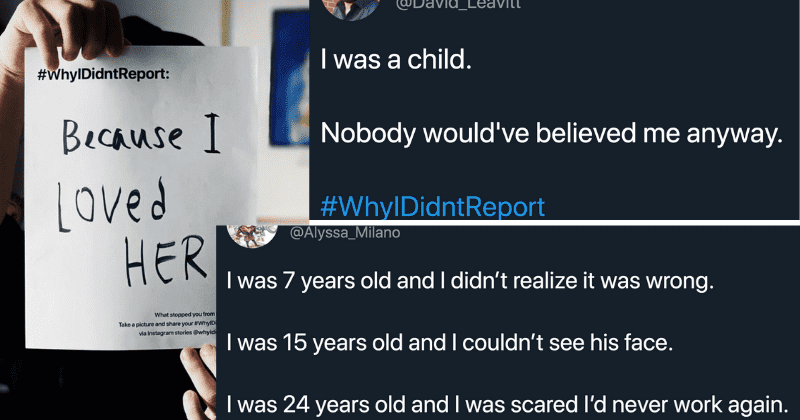
The #WhyIDidn’tReport trend showed all the reasons why victims don’t report. CNN made a collection of the tweets of victims and put them into categories. One of those categories is, “They are made to feel it’s their fault”, and according to CNN, “Victims say that when they do speak up, they are met with judgment and not support. "What were you wearing?" they're asked. "How much were you drinking?"’
This is just one of the common reasons for not speaking up. After their attack, some victims are threatened to keep their mouths shut. This falls under the “They’re afraid of repercussions” category. Other victims are “told to dismiss it” to protect the attacker or to avoid embarrassment. Victims are also afraid that they wouldn’t have enough evidence to prove their attack in court. In certain situations, they’re scared that people won’t believe them because it was a family member or an upstanding person in the community. Going to court also involves the victim possibly coming into contact with their perpetrator and this turns many victims away. This ties into the common feeling of not wanting to relive their attack. Going to court means that they would have to give all the details and talking about it can make the victim extremely upset or uncomfortable.
The victim faces many problems before they even report their attack, but we’ll tackle this later. What about what happens when they do report? Like I previously mentioned, the statistics for the number of rapists that actually do time, is tremendously low. The reason for this is a whole other problem.
In the article, “How to Lie with Rape Statistics: America’s Hidden Rape Crisis”, by Corey Yung, evidence is revealed to show what happens when a victim reports their attack. In summary, when police departments receive rape reports, many of them are dismissed. The reports are either considered “unfounded” causing them to have no investigation, classified as a lesser defense, or the officer simply doesn’t create a written report of the rape complaint.
Let’s see what we have so far: victims are judged for not reporting their attack. Then they explain that they were threatened not to report, were too young to know to report, or were told that was actually their fault. Or they actually do report their attack and their case is immediately dismissed. But let’s take this one step further, what if their case makes it to court?
According to The Washington Post, only 0.6% of rapists get incarcerated and only 0.7% become a convicted felon. Even after reporting and going to court, victims have a very slim chance of receiving justice. Let’s say the perpetrator does get incarcerated, there’s still a chance that they could be bailed out. That’s what happened to my friend. Her perpetrator was incarcerated and then bailed out days later. Now she has to live with the fear of him coming back and even running into him.
In the situation of rape, the victim will not only suffer from trauma, but will also face a number of problems when telling others about it, reporting it, and attempting to receive justice. Meanwhile, the rapist has an extremely high chance of walking free. This is a huge problem, but little is being done to fix it. The way society judges the victim needs to change and the way their cases are handled needs to change.
People need to be educated on how to react when a victim tells them about their attack. Victims should be met with support, not judgement. Asking them what they were wearing or if they were drinking, are completely irrelevant questions. It needs to become better-known that it isn’t the victim’s fault. Believing the victim needs to be the regular response.
The justice system for rape cases needs to be entirely reconstructed. Sexual assault reports need to be taken seriously. Victims should not have to face their perpetrator and should be given the support they need to recover. Resources like therapy should be supplied to the victim. But the root of the problem is that people need to know not to rape others.
This once again may sound obvious, but many people don’t know about the rules of consent. Consent should be taught in health classes and we should continue to raise awareness, so all ages know about it. Everyone just needs to listen to Amber Rose and her explanation of consent.
While sexual assault is still a massive problem, the justice system needs to be changed and people should know not to judge the victim. In the future, all people should know not to rape someone in the first place.


Comments
Post a Comment